Webflow Localisation: A Guide for Global Success
New Zealand businesses have always needed to think internationally. With a domestic market of just over five million people, global reach is not optional. It is the growth strategy. Webflow localisation makes that expansion significantly more achievable by keeping translated content, metadata, layouts, and publishing workflows inside a single platform. Teams can choose Webflow and scale across regions without fragmenting their CMS, SEO foundations, or design system. For NZ companies targeting a global audience, website localisation through Webflow replaces the complexity of running separate sites or managing third-party tools with a single, maintainable system.
What is Webflow Localisation?
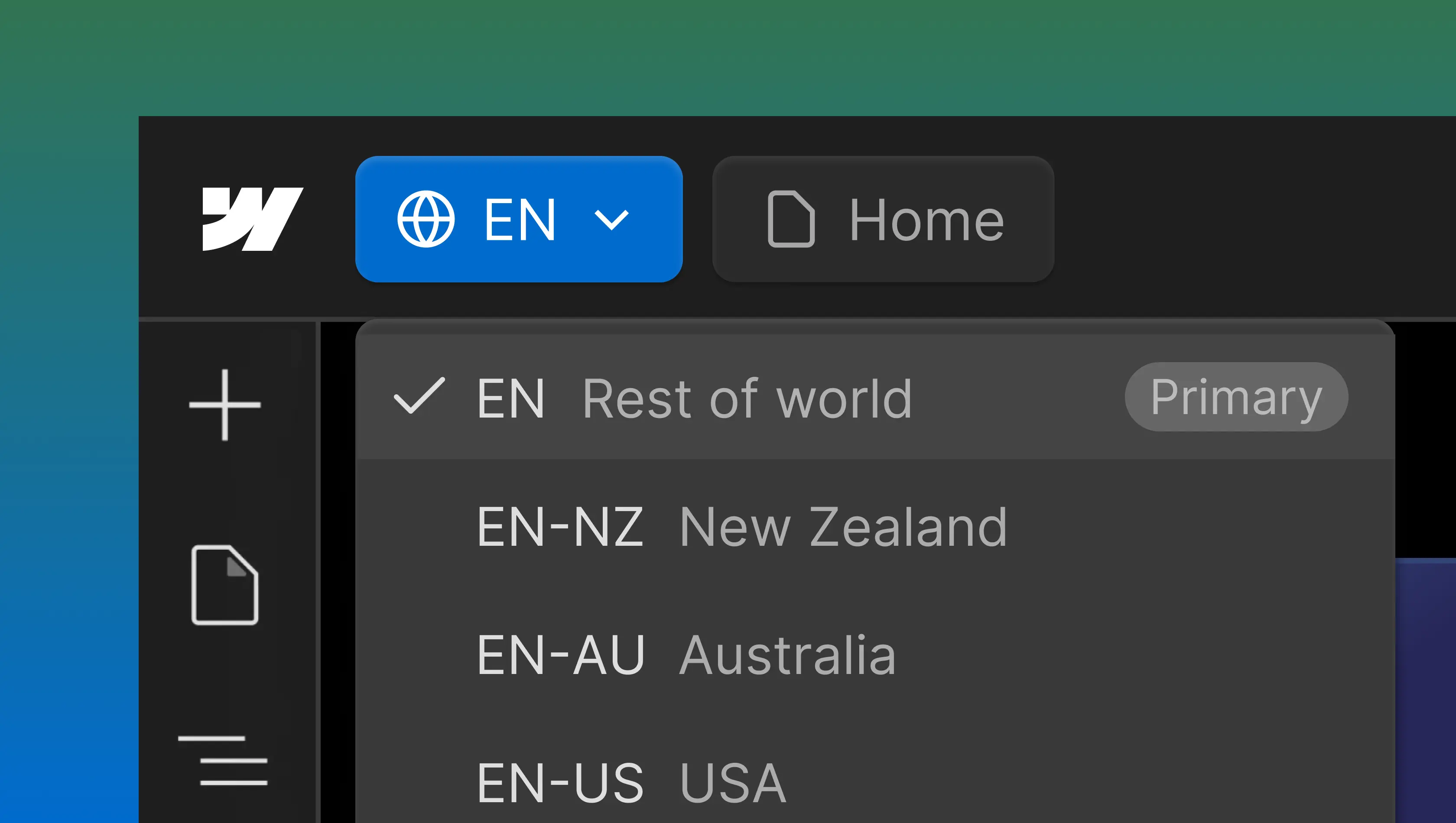
At its core, Webflow localisation is the platform's native approach to managing a multiregional website. Teams define a primary locale, configure different locales for each target market, and produce localised versions of pages, CMS content, and metadata directly within the Webflow Designer. No third-party tools are required for any of this.
What sets this apart from plugins like Weglot is that Webflow's localisation features sit inside the platform itself. Translated content, layouts, SEO settings, and publishing workflows are not bolted on. They are part of the same system your team already works in. As your organisation expands, each new locale scales within that system. There is no overhead from managing separate sites or patching together external tools. Every version of your site shares a single underlying structure, adapted to suit a specific target market.
For NZ teams expanding across multiple regions with different languages, this is particularly valuable. The same system that handles your domestic English-language site can manage a multilingual website serving the US, Europe, or Asia, with no additional tooling required.
Many teams underestimate this opportunity by treating localisation purely as a translation exercise. In reality, tone, layouts, fonts, imagery, and local context should all be tailored per locale to create something that feels genuinely relevant.
Why Localisation Matters
Scaling internationally without rebuilding your website for each region is the central promise of localisation. For New Zealand companies, where the path to growth almost always runs through Australia, the US, or further afield, it also means maintaining visibility across search engines and AI-powered results without the operational burden of several disconnected sites. A single Webflow site serving localised versions across markets reduces complexity, minimises rework, and keeps brand consistency intact.
User Experience
Friction kills conversions. When visitors land on content that reflects their local language expectations and cultural references, they engage more deeply and convert more readily. For a NZ SaaS company targeting North American buyers, this might mean swapping "organisation" for "organization", replacing local case studies with US-relevant proof points, and adjusting imagery to reflect a different market context. Localised content across both static pages and CMS-driven content keeps users on the page longer and guides them more naturally toward action. Even small details like date formats, terminology, and seasonal references contribute to a user experience that feels intentional rather than generic.
SEO
Regional search behaviour does not follow a universal pattern. Keywords that drive traffic in New Zealand may underperform entirely in Australia or the United States. Localised SEO gives teams the ability to optimise metadata, pursue regional keyword strategies, and send the right signals to search engines through Webflow-generated hreflang tags and clean URL structures. Without this deliberate approach, rankings tend to plateau as international traffic grows, with different locales competing against each other rather than reinforcing a single domain's authority.
AEO
Answer engine optimisation is an increasingly important consideration as users discover content through AI-powered tools like ChatGPT, Claude, and Perplexity. When the same query appears in different languages or regional contexts, the intent behind it can shift meaningfully. Locale-specific content structure improves AI visibility, something that matters beyond traditional rankings alone.
Conversion Optimisation
Generic global content rarely outperforms region-specific messaging. Proof points, calls to action, and credibility signals that resonate with a NZ audience may carry little weight when targeting international audiences in Europe or the Americas. Getting conversion right across markets is not simply about translation. It demands a platform that provides genuine control over each localised site and a build structured to support differentiation from the start.
Webflow's Localisation Features
Webflow has invested in a set of localisation features that support end-to-end localisation natively, without external plugins. For NZ teams evaluating platforms for international expansion, understanding these capabilities before committing is worth the time.
Content Inheritance & Publishing
Every secondary locale inherits content from the primary locale, providing a working baseline that teams can override selectively. This inheritance covers copy, images, layouts, alt text, and metadata. The practical benefit for NZ businesses is significant: launch your domestic site with polished content while international locales remain works in progress. CMS items support draft status on a per-locale basis, ensuring untranslated or incomplete pages never reach the wrong audience. Independent publishing controls mean teams can roll out localised content to Australia first, then the US, then additional markets, each on its own timeline.
When your primary locale serves New Zealand and secondary locales cover Australia, the US, or the UK, most English-language content carries across with selective overrides for spelling, terminology, regulatory references, and regional proof points.
URL Structure & SEO
Clean URL architecture is critical for international SEO, and Webflow delivers this through a subdirectory structure. Subdirectories consolidate domain authority under a single root, a significant long-term advantage over subdomains, which are reserved for enterprise scenarios. Webflow generates hreflang tags automatically from your configured locales, producing correct URL structures and signalling to search engines exactly which language or regional version should be served to each audience. This automation removes one of the most error-prone aspects of international SEO implementation.
Language Detection & Switcher
Webflow includes automation that detects a visitor's browser language and suggests the most appropriate localised site. Paired with a native locale switcher, typically a dropdown in the navbar or footer, this gives visitors direct control over their experience. Placement matters: in our experience building sites for NZ companies expanding internationally, navbar placement consistently outperforms footer for switcher engagement. The built-in switcher works entirely within the Webflow Designer and requires no third-party tools.
CMS & Collection Items
Each collection item supports localised variants while sharing a single schema. For content-heavy NZ sites managing blogs, case studies, or resource libraries across multiple markets, this architecture avoids duplication entirely. New locales can be added without rebuilding your content architecture. The same CMS structure scales as your market presence grows.
How It Works
Localisation is a paid add-on available on any Webflow site plan. Teams can explore the functionality for free before committing to publish. The most important decision happens early: defining a localisation plan before CMS collections are built, not after. NZ companies that get this architecture right upfront avoid the significant rework that catches teams who treat localisation as an afterthought.
Localisation Setup
Enabling localisation adds a secondary locale configuration alongside your primary locale. Each locale, whether it represents Australia, the United States, or a non-English-speaking market, generates its own version of your site under a dedicated URL path. The Webflow Designer offers a localisation-specific editing mode, allowing teams to work on individual locales without disrupting the primary locale. For most NZ businesses, the natural progression is an Australian locale first, followed by the US or a broader international English version.
Management of Translated Content
Adding translated content can be done manually or with Webflow's built-in translation tools. Machine translation serves as a useful starting point for initial drafts, but relying on it for conversion-critical pages is one of the most common mistakes we see NZ marketing teams make when scaling internationally. Manual translation remains strongly recommended for marketing copy, legal content, and anything intended to drive action.
The localisation work does not stop at text. Images, layouts, and fonts frequently need adjustment, especially for languages such as Spanish, French, Arabic, and Hebrew where text length and reading direction differ substantially. Post-launch, each localised site should be tested independently. Ongoing updates need to follow a defined localisation process so that changes to shared components do not inadvertently affect localised versions across your other markets.
Webflow Localisation vs Third-Party Tools
Tools like Weglot and Lokalise have their place, but they introduce trade-offs that compound over time. Plugins tend to inject scripts, create duplicate content structures, and restrict how much control teams have over SEO and CMS behaviour. For NZ businesses building for the long term, this technical debt becomes a real constraint.
Webflow's native localisation sidesteps these issues entirely. SEO settings, CMS content, layouts, and publishing workflows remain centralised within the platform. Because localisation is built into the Webflow Designer rather than layered on top, the system stays manageable as your website grows. When evaluating platforms, this centralised approach deserves serious consideration alongside the alternatives.
Larger organisations benefit from Webflow's enterprise plan, which introduces custom roles and publishing workflows for granular control over who can edit, review, and publish across each locale. This positions Webflow as a credible alternative to standalone translation management systems, offering governance without the overhead of a separate platform. On pricing, keeping localisation native also means fewer third-party tools to pay for, reducing long-term costs and operational complexity.
Localisation Best Practices
Getting localisation right starts well before any content is translated. A solid localisation plan should be developed alongside your information architecture, CMS design, and SEO strategy, not retrofitted after launch. Adding localisation to an existing site is possible, but it almost always introduces rework.
For NZ companies, prioritising markets is essential. Australia is the natural first step, followed by the US or UK depending on where your strongest commercial opportunities lie. Phased rollouts allow teams to validate performance, refine workflows, and build confidence before expanding further. Draft status on CMS items makes this practical. Teams can publish polished, fully localised content to priority markets while keeping other locales in progress behind the scenes.
Brand consistency across locales is easier to maintain with a strong global brand system. Webflow's design system supports this far more effectively than platforms that treat each locale as a separate build, making it simpler to adapt messaging for different languages while preserving a cohesive experience across every version of your site.
Localisation also requires ongoing investment. SEO and AEO performance, rankings, and engagement metrics should be reviewed per locale so that each version of your website continues to perform as your international audience grows. For implementation specifics, Webflow's own documentation provides a detailed step-by-step tutorial that is a seriously useful companion to any build.
Key Takeaways
For NZ marketing teams looking to take their website international, Webflow localisation offers a way to scale without fragmenting the website, CMS, or design system that holds everything together. The platform's continued investment in localisation, including native locale switching, automatic hreflang tag generation, CMS draft status per locale, signals a clear commitment to supporting teams operating across international markets.
Localisation is not just about translation
The full experience should be adapted per locale: layouts, fonts, imagery, and metadata all deserve attention, not just the copy itself.
Planning matters
How your CMS structure and page architecture are designed has a direct bearing on how cleanly localisation scales. Building this into your information architecture from the outset avoids significant rework down the line.
Native beats bolted-on
Centralising SEO settings, publishing workflows, and CMS content within Webflow removes the compounding complexity that comes with third-party plugins layered on top.
Control is built in
Per-locale draft status, a native locale switcher, automatic hreflang tags, and custom publishing workflows available on the enterprise plan give teams the ability to deliver highly relevant content to each market, without exposing incomplete work.
A clear localisation plan, combined with the right platform, enables strong localised SEO, a better user experience, and sustainable global reach.
Webflow localisation is something we are being asked about more and more at Edition. Most recently, we supported Halter, a high-growth New Zealand agritech company expanding into international markets, with the localisation layer of their global marketing strategy. If you are exploring Webflow for a new multi-market website, or considering localisation for an existing build, feel free to get in touch.
FAQs
Is localisation available on all Webflow plans?
Localisation is offered as a paid add-on across all Webflow site plans, with no minimum tier requirement. Two tiers exist at the time of writing: Localisation Essential, supporting up to 3 locales, and the Advanced plan, which extends to 10 locales and includes asset localisation, localised URLs, and automatic visitor routing. The enterprise plan unlocks custom roles, unlimited locales, and custom pricing.
Can I add localisation to an existing Webflow site?
Absolutely. Localisation can be enabled on any existing Webflow site. The caveat is that CMS structure and page architecture significantly affect how smoothly the process scales. Teams adding localisation post-launch should expect some restructuring, particularly around CMS collections and URL paths.
How does Webflow handle localised SEO?
Hreflang tags are generated automatically based on your configured locales. Webflow also manages subdirectory URL structures natively and supports localised metadata on a per-page basis, covering the core technical requirements for international SEO without manual setup.
What is the difference between a primary locale and a secondary locale?
Your primary locale is the default version of the site, the baseline from which all other locales inherit. Secondary locales allow teams to override copy, images, layouts, and metadata for each target market. Per-locale draft status ensures only complete, fully localised content goes live.
Does Webflow support right-to-left languages?
RTL text is supported for languages like Arabic and Hebrew. More complex layouts may need additional custom CSS for reading direction and text alignment, particularly on heavily customised page designs.
How does the Webflow locale switcher work?
The native locale switcher can sit in either the header navigation or footer. No third-party tools needed. It allows visitors to move freely between language versions or regionalised versions of your website. Combining the switcher with Webflow's automatic language detection, and optionally an IP-based redirect prompt, helps surface the most appropriate localised site based on browser settings and visitor location.