The Ultimate SEO Guide for Webflow

Webflow is the platform we use most for website builds at Edition. It consolidates web design, content management, hosting, and SEO controls into a single visual development platform. No-code by default but open to custom code when needed, it removes the plugin dependencies, database overhead, and theme conflicts that hamper other website builders. Is Webflow good for SEO? We are confident it is, and this guide lays out the case in detail.
That said, platforms do not rank sites on their own. Webflow takes care of the technical floor; strategy, content, and expertise determine the ceiling. This guide covers on-page fundamentals, CMS architecture, schema markup, localization, and the errors that most often hold Webflow sites back. The aim is actionable guidance you can apply to optimize your site right away.
Why Webflow is Built for SEO
What Webflow handles natively
Clean code and semantic HTML come standard with every Webflow build. There is no plugin bloat, no database queries adding latency to page loads, and no theme conflicts breaking your markup. Search engines consume your HTML directly, and fewer obstacles in the code mean more efficient crawling of your page content.
Every Webflow site ships with direct control over meta titles, meta descriptions, Open Graph meta tags and images, and custom URL slugs across pages and CMS items. XML sitemaps are generated and maintained automatically. The design canvas produces responsive, mobile-friendly layouts by default, requiring no additional configuration. Webflow also handles CSS and JavaScript bundling, image compression, and global CDN hosting, each contributing to fast load times.
Contrast this with platforms like WordPress, where SEO functionality depends on plugins such as Yoast or Rank Math. Webflow delivers these SEO features as part of the core product. The SEO capabilities are built in, not added on.
Where expertise still matters
Webflow handles the infrastructure. It does not handle the decision-making. Keyword research, search intent analysis, content strategy, link acquisition, and adapting to algorithm changes are disciplines where human expertise drives outcomes.
The platform will not tell you which pages to create, which topics to target, or how to develop high-quality content that earns backlinks. Those are the decisions that determine whether a site occupies page one or page five, and whether it gets cited by AI tools like ChatGPT, Perplexity, and Claude, or goes unnoticed.
Whether the goal is traditional search rankings or visibility in AI-generated answers, the fundamentals are the same: clear structure, quality content, and strong technical foundations. Webflow provides an excellent toolkit for building a Webflow website, but the organic traffic a site ultimately earns depends on what is done with those tools. For US companies competing in global markets, or international businesses targeting American audiences, getting the strategic layer right is what turns a technically sound site into a growth channel.
On-Page SEO in Webflow
On-page SEO covers everything that can be optimized directly on the webpage to improve search rankings and drive relevant organic traffic.
Page titles and meta descriptions
The page title is one of the most powerful on-page ranking signals and the first element users encounter in the SERP. Webflow gives every page and CMS item dedicated fields for page titles (also referred to as title tags or SEO titles) and meta descriptions, located in the page settings panel.
Page titles should stay under 60 characters, include the target keyword naturally, and accurately describe the page content. Meta descriptions do not carry direct ranking weight, but they have a major effect on click-through rates. Aim for 150 to 160 characters and include relevant keywords wherever the language flows naturally.
On CMS-driven pages, dynamic fields handle meta title and description generation automatically, ensuring every blog post or product page carries unique metadata with no manual input required.
Heading structure
Headings (H1 through H6) make page content scannable for users and convey topic hierarchy to search engines. A logical header and heading structure also improves accessibility, since screen readers use headings as their primary means of navigating the page.
Webflow assigns heading tags through element settings, completely separate from visual styling. The standard practice is one H1 per page, H2s for primary sections, and H3s for supporting detail.
URL architecture
Clean, descriptive page URLs are a foundational expectation for usability and SEO. Webflow allows the slug to be customized for every static page and CMS item, and CMS collections produce readable page URLs dynamically at scale.
If a Webflow website uses a subdomain (for example, blog.yoursite.com), search engines may treat it as a separate entity. Subfolders (yoursite.com/blog) consolidate domain authority more effectively in most scenarios.
Image optimization and alt text
Images are critical to user experience but also the most common source of slow page speed. Every uncompressed image increases the page load, inflating load times and eroding website performance.
Webflow compresses images automatically and supports lazy loading out of the box. Best practice is to use modern formats like WebP where practical, with images sized to match their actual display dimensions. Alt text (also known as alt tags) communicates image content to users who cannot see it, including those depending on screen readers, and supplies search engines with additional context.
Every image should carry descriptive, accurate alt text that weaves in relevant keywords naturally while keeping the human reader front and center. Webflow can also generate alt text using AI. As a pro tip, defining alt text at the asset level ensures it carries across every instance of that image on the site.
Internal linking
Internal linking creates connections between pages on a Webflow site, enabling search engines to discover content, map page relationships, and distribute link equity.
Webflow's link settings make connecting to any page, CMS item (a blog article, case study, or similar), or section straightforward. Directing links from high-authority pages toward those that need reinforcement, using descriptive anchor text, is one of the most undervalued on-page SEO tactics, and one where effort scales directly with returns.
Technical SEO
Technical SEO is the infrastructure layer that ensures search engines can crawl, index, and render a Webflow site effectively. Webflow covers much of this natively, though understanding the underlying mechanics pays dividends.
Sitemaps and robots.txt
An XML sitemap covering every published page and CMS item is generated automatically by Webflow. It can be submitted to Google Search Console directly. Individual pages can be excluded from indexing through page settings, and individual CMS items can be excluded through their item settings on paid site plans, providing granular control over what search engines access.
The robots.txt file tells crawlers which sections of a site to access and which to avoid. Webflow makes this editable through the site settings panel. Both the sitemap and the robots.txt file sit at their standard paths, exactly where search engines look for them.
For teams interested in answer engine optimization (AEO), Webflow supports adding a native llms.txt file, providing structured information about the site for large language models.
Canonical tags and duplicate content
Identical content at multiple URLs presents a problem: crawlers cannot determine which version should be indexed, and search rankings are diluted as a consequence. Canonical tags solve this by indicating the preferred URL.
In Webflow, canonical URLs are configured through the page settings for both static pages and CMS items.
Redirects
When pages are moved or removed, 301 redirects safeguard the SEO value accumulated at the original URL. Without them, the outcome is 404 errors, forfeited link equity, and a diminished user experience.
Webflow provides a straightforward interface for managing 301 redirects in the project settings.
CMS & Content Architecture
The Webflow CMS is where SEO truly scales. A well-planned CMS converts a content library into a connected network of optimized pages, rather than an unstructured collection of posts.
Structuring collections for search
Webflow CMS collections define custom content types: blog posts, case studies, team profiles, product pages, and more. Collection fields should encompass meta titles, meta descriptions, featured images with alt text, author references, and any structured data the site requires. The goal is that every item published through the Webflow CMS is SEO-complete by default.
Categories, tags, and reference fields create logical groupings that benefit user navigation and search engine comprehension alike. High-quality, well-organized quality content is easier to crawl, link to, and rank.
SEO settings for CMS items
Every CMS item in Webflow has its own page settings panel containing fields for meta title, meta description, open graph image, and canonical URL. These can be populated dynamically from collection fields, scaling unique metadata across hundreds of pages. Auditing CMS SEO settings on a regular basis is strongly recommended; items published with default or empty metadata are a frequent gap in high-velocity content operations.
Scaling internal linking through the CMS
The CMS transforms internal linking from a manual task into a systematic one. Reference fields and multi-reference fields establish relationships between collections, and templates render those relationships as contextual links. Blog posts can surface related case studies automatically; product pages can link to supporting resources.
This functions as the internal equivalent of building backlinks. Unlike external backlinks, it is fully within the team's control and can be executed immediately.
Localization & International SEO
International expansion brings SEO complexity that goes well beyond translation. Search engines need clear signals about which content is meant for which audience.
How Webflow handles multilingual SEO
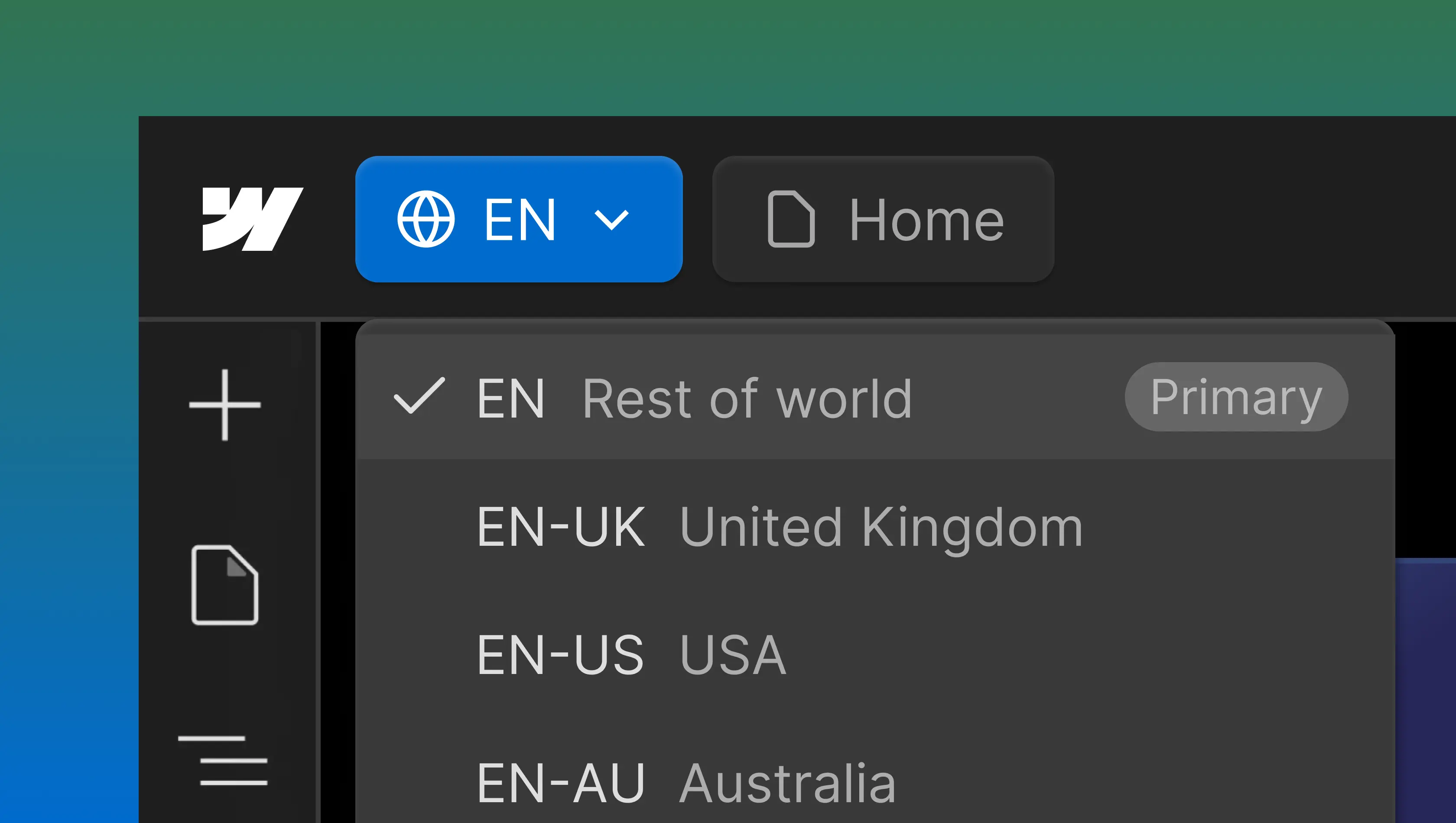
Webflow's native localization features allow locale-specific content versions to be created inside a single project. Each locale carries its own translated or adapted content, metadata, and URL structure. For the bulk of multilingual SEO requirements, Webflow manages the technical overhead natively, including automatic hreflang generation and localized sitemaps. Third-party plugins like Weglot remain an option for teams managing many languages or needing AI-powered translation workflows.
Hreflang and locale structure
Hreflang tags tell search engines which language and region each content version is intended for. Without them, search engines may serve the incorrect locale or treat translated pages as duplicate content.
Webflow handles hreflang implementation automatically. Once localization is enabled, hreflang tags are generated for all static and CMS-driven pages, covering appropriate language-region pairs (such as en-us, en-gb, or es-mx) plus an x-default tag for the primary locale. Tags appear in the page-level HTML and the auto-generated sitemap. Subfolders (/us/, /uk/, /es/) are the default URL structure, keeping all page URLs under a single domain and consolidating authority. Teams that need finer control can disable hreflang auto-generation and implement a custom JavaScript solution instead.
Content variation across markets
Effective international SEO goes beyond translation. Keyword research should be conducted independently for each locale, since the terms one market uses may differ significantly from another. Search intent can shift between regions as well. Webflow's CMS supports content variations across locales efficiently, so every market receives high-quality content tailored to its particular context.
Schema Markup in Webflow
Schema markup is structured data added to a page's HTML that gives search engines explicit context about page content, including properties such as pricing, availability, authorship, and publication dates.
The payoff is richer SERP listings. Schema can generate rich snippets displaying star ratings, pricing, FAQ dropdowns, and event dates, all earning higher click-through rates than plain blue links. Which schemas to implement depends on the site in question. Ecommerce sites should prioritize Product schema (including pricing data), content-heavy sites benefit from Article schema, and local businesses gain visibility through Local Business schema.
Webflow now ships with a built-in schema markup generator that can create structured data from visible page content automatically. On CMS collection pages, Webflow AI generates schema pulling in relevant dynamic fields. Custom code embeds are available for advanced requirements, and SEO tools such as Google's Structured Data Markup Helper can assist with initial implementation. Validation using Google Search Console's Rich Results Test confirms that structured data is rendering correctly.
Common Webflow SEO Mistakes
Even with strong native SEO capabilities, several common errors continue to trip teams up.
Missing or duplicated meta titles
Every page needs a unique, descriptive meta title. When SEO titles are duplicated across pages, search engines interpret this as multiple pages covering the same ground, which dilutes search rankings for each. Running a title tag audit across all static pages and CMS items in the page settings catches this early.
Unoptimized images
Large images remain the number one cause of poor page speed on Webflow sites. Each image should be compressed, formatted appropriately (WebP where supported), and sized to match its display dimensions. Missing or generic alt tags represent a wasted opportunity for search engines and screen readers alike. Webflow's AI-powered alt text generation can help close the gap, though reviewing generated output for accuracy is still advisable.
Excessive third-party scripts
Every third-party script contributes to page load time. Analytics trackers, chat widgets, heatmaps, and marketing pixels each pull in JavaScript and compete for rendering priority. This is the one area where Webflow's otherwise strong website performance can suffer. The impact is cumulative: ten scripts each making their own network requests can add seconds to loading speed.
Overlooking CMS-driven pages
Teams often invest heavily in optimizing static pages while treating CMS-driven content as secondary. Every blog post, case study, or product page generated by the Webflow CMS is a unique webpage with its own ranking potential. Dynamic meta titles, descriptions, and Open Graph data should be configured correctly for every CMS page content template.
Forgetting 301 redirects
This is the error with the longest recovery timeline. Without 301 redirects mapping old URLs to their new counterparts, link equity accumulated over time is lost, 404 errors proliferate, and external backlinks break. The redirect map should be built before a new website launches, not after the fact. Web design projects that skip this step spend months recovering lost SEO value.
SEO Strategy (Before You Touch Webflow)
Effective SEO starts before the Webflow Designer is opened. Search engine optimization begins with keyword research: determining what the target audience is searching for, the language they use, and the search intent behind each query.
Keywords should be assigned to specific pages, with each page targeting a distinct set of relevant keywords and fulfilling a clear user intent. When two pages target identical terms, they compete against each other instead of strengthening search rankings. Site structure needs to be planned with search visibility as a priority: a logical hierarchy and clear navigation paths keeping important content within a few clicks of the homepage. Flat architectures underpinned by strong internal linking consistently outperform deep, siloed structures.
This strategic layer is what separates a Webflow site that ranks from one that simply exists. The platform delivers the functionality to execute; the SEO strategy delivers something worth executing. For beginners, this planning phase may feel abstract, but the teams that invest in it are the ones that see compounding organic traffic over months and years.
In Summary
Webflow offers a comprehensive, SEO-friendly platform that handles the technical foundations most website builders require plugins or workarounds to address. Clean code generation, native metadata controls, automatic XML sitemaps, responsive design, and fast hosting provide a strong starting point, but a starting point is all it is.
Achieving and maintaining strong SEO performance requires strategic keyword research, disciplined on-page optimization, thoughtful content architecture, and continuous monitoring through tools like Google Analytics and Google Search Console. You can use Webflow to handle the technical layer, but the expertise determines how far the results extend.
Edition's approach to SEO-optimized Webflow websites pairs deep platform expertise with dedicated SEO strategy. Site architecture, CMS structures, page templates, schema markup, hreflang, canonical tags, and redirect management are built into every engagement.
If you are looking to build or improve an existing Webflow website with SEO at the core, get in touch.